Showing posts with label Constitutional Law. Show all posts

Jun 29, 2026

Wisconsin Early Voting Gets Surprise Boost from Ballot Mail-in Case, Watson v RNC

Molly McGrath (left), a voting rights attorney with the ACLU, 
works with Madison residents to get IDs they need to vote under 
Wisconsin’s strict voter-ID law. Early voting efforts by election 
clerks in metro voting districts
increased voter turnout following
a pro-voting rights win in federal district court in One Wisconsin 
Institute v. Thomsen
(2016) that swept away Wisconsin Republican 
voter-obstruction legislation. Today, early voting received another 
boost from the U.S. Supreme Court in the election law case that 
rejected Republicans' legal theory that federal law requires 
states to reject absentee ballots received after election day. Early 
voting was not at issue in Watson v Republican National Committee,
and came up in oral arguments in March 13, 2016.
(Photo courtesy of Molly McGrath) 
Republican Legal Theory Limiting Voting Is Rejected by U.S. Supreme Court

MADISON, WIS. — A  major front in Trump's war against voting was dealt a 5-4 defeat Monday in the closely watched election law case, Watson v. Republican National Committee.

The U.S. Supreme Court 
majority opinion is authored by Justice Amy Coney Barrett, and brought together Chief Justice John Roberts and the Court's three liberal justices.

Trump, the U.S. DoJ and national and state Republicans had decided states should only count mail-in ballots received on or before Election Day, federal law requires states to reject absentee ballots received after election day. Both propositions were rejected.

Republicans challenged a Mississippi statute that allows ballots postmarked by Election Day.

Mississippi is one of roughly 30 States that count some absentee ballots mailed by election day but received afterward, Barrett noted.

Republican Legal Theory Rejected

The Republican position
 is soundly rejected in Watson v. Republican National Committee, in which Justice Barrett concludes, "The question today is not whether requiring ballots to be received by election day is a good or bad idea; the question is whether the idea has made its way into the United States Code."

Early Voting Gets Explicitly Affirmed

Early voting efforts, especially in Wisconsin that has substantially utilized early voting efforts by 
election clerks in metro voting districts the last eight years, were given an unexpected affirmation by Watson v. Republican National Committee, after years of state partisan battle with Wisconsin Gov. Scott Walker, (2011-19).

The issue of early voting is not of issue in Watson, but arose in oral arguments and in briefing, in which litigants and the Court argued whether federal election-day statutes prevent states from counting mail-in ballots that are postmarked by Election Day, but arrive up to five days later, as in Mississippi.

In oral arguments justices frequently push lawyers to apply their legal theories to hypothetical situations. Both the 
Republican National Committee and U.S. Department of Justice attorneys agreed in oral arguments federal election-day statutes permit early voting, Barrett pointed out.

Paul D. Clement, Alexandria, Va.; and D. John Sauer, Solicitor General, U.S. Department of Justice, Washington, D. C. (for United States, as amicus curiae) argued the RNC's case at oral arguments as respondents.

Early Voting in Wisconsin


In federal district court in One Wisconsin Institute v. Thomsen (2016) a landmark voting rights win swept away much Wisconsin Republican voter-obstruction legislation2013 Wisconsin Act 146, that included curtailing in-person absentee voting, early voting, aimed at minorities in Madison and Milwaukee.

In One Wisconsin Institute v. Thomsen, (2016), U.S. District Judge James Peterson writes:

Plaintiffs (voting rights advocates) have adduced evidence that weekend and evening voting is particularly important for socioeconomically disadvantaged voters, and that, in Wisconsin and nationwide, African American and Latino voters have made particularly good use of various forms of early voting. 
Early voting in groups on Sundays—including church-supported “Souls to the Polls” efforts—is a widespread practice among African American voters, in Wisconsin and nationwide.
But again, a disparate impact, without more, does not prove intentional discrimination.
But plaintiffs have more. Statements by legislators show that Act 146 reduced the hours allowed for in-person absentee voting specifically to curtail voting in Milwaukee, and, secondarily, in Madison. [State] Senator Grothman made repeated statements objecting to the extended hours for in-person absentee voting in Milwaukee and Madison, indicating that hours for voting needed to be “reined in.” On the floor of the senate, he said, “I want to nip this in the bud before too many other cities get on board.” 
Senate Majority Leader Scott Fitzgerald made similar comments. As he put it, “But the question of where this is coming from and why are we doing this and why are we trying to disenfranchise people, I mean, I say it's because the people I represent in the 13th district continue to ask me, ‘What is going on in Milwaukee?’ ...
The legislature's ultimate objective was political: Republicans sought to maintain control of the state government. But the methods that the legislature chose to achieve that result involved suppressing the votes of Milwaukee's residents, who are disproportionately African American and Latino. The legislature did not act out of pure racial animus; rather, suppressing the votes of reliably Democratic minority voters in Milwaukee was a means to achieve its political objective. But that, too, constitutes race discrimination.

Many Wisconsin cities did get on board promoting early voting in response to the District Court's 2016 evisceration of 2013 Wisconsin Act 146.

Now, the U.S. Supreme Court has given
 One Wisconsin Institute v. Thomsen precedent protection in a case that will control expected Republican legal and state counter offensives.

Notes Jacob Knutson on early voting in 
Watson v. Republican National Committee in Democracy Docket:

In the case, [Watson] the RNC argued that Mississippi’s law offering a grace period for late-arriving ballots mailed by Election Day violated the election-day statutes: a set of federal laws that designate 'the Tuesday next after the first Monday in November… as the day for the election' for federal elections. ...

[T]he Court disagreed, ruling that the states 'do not set a deadline for ballot receipt' and therefore 'do not prevent Mississippi from counting ballots postmarked after election day yet received afterward.'

Barrett added that if the Court adopted the RNC’s legal theory in the case, 'early voting would also be at risk.'

'At bottom, plaintiffs’ theory is that because we are governed by 19th-century election-day laws, we are also governed by 19th-century voting practices,' she wrote. 

Going further, Barrett warned that, 'Carried to its logical conclusion, this theory would call into question the way modern elections work.'

Barrett noted in the opinion that the RNC and Department of Justice (DOJ) —  which joined the RNC in challenging Mississippi’s law — both agreed in oral arguments earlier this year that the election-day statutes permit early voting.

'Although the election-day statutes refer to a particular ‘day’ for the election, plaintiffs do not contend that everything must occur on that day,' Barrett wrote. 'For instance, they do not object to early voting or dispute that officials may count votes and certify a winner after election day."

Though he dissented from the Court’s decision on late-arriving mail ballots, Justice Samuel Alito agreed with the majority that the election-day statutes permit early voting.          

Thus, we see a Supreme Court voting rights case deciding the issue presented—affirming states can allow one class of voters to be counted, those whose absentee ballots arrive after Election Day while being postmarked by Election Day—and explicitly protecting a different class of absentee voters, early voters, after discussion in oral arguments.

There will a reckoning from Republicans in Wisconsin, and across the nation.

Jul 25, 2022

Wisconsin's New Qualification for Voting: Physical Ability, Faces Constitutional, Federal-Law Challenge

Lawsuit: Carey et al v. Wisconsin Elections Commission et al (Civil  Case No: 22-402)
Promises Legal-Moral Spectacle


Madison, Wisconsin — Wisconsin Republicans may have overplayed their political hand in their legal war against voting.

Many disabled Wisconsinites believe they may vote, though they need to vote absentee and physically cannot travel to election clerks and drop off their absentee ballots. They believe their voting franchise persists, irrespective of physical ability.

Wrong, say Republicans on the Wisconsin Supreme Court, (not really a Court, just a raw political body, protected by both Democrats and Republicans), in its July 2022 edict-opinion in Teigen v. Wisconsin Elections Commission (Case NO.: 2022AP91). (See Teigen opinion and Teigen case history.) (See also Law Forward.)

The Wisconsin Supreme Court ruled absentee ballot drop boxes are henceforth illegal and that only voters can return their absentee ballots in person to their clerk’s offices or official designated sites, drop boxes.

If physical ability prevents voters from returning their ballots without help, too bad is the effect of the ruling and a seemingly purposefully provocative statement of interpretation of Teigen from Meagan Wolfe, Democrat-leaning Administrator of the Wisconsin Elections Commission: "the voter is the one required to mail their ballot," (CBS News-Minnesota).

Disabled Wisconsinites and their supporters say corrupt Wisconsin justices are ignoring federal law and the United States Constitution, citing several Amendments, the powerful Americans with Disabilities Act (ADA), the Voting Rights Act, and other federal legislation. See also Associated Press.

Even Frank Easterbrook, ace Republican operative on the Court of Appeals for the Seventh Circuit, is thought to have a tough time [for his future anti-voting moves] with this new scheme to stop voters unpopular with Republicans.

The case is currently before the liberal-dominated U.S. District Court for the Western District of Wisconsin.

The case is Timothy Carey v Wisconsin Elections Commission.

The complaint reads in part:

Some voters with disabilities, including Plaintiffs, require ballot-return assistance and are physically incapable of voting in person on election day.
For these voters, Wisconsin’s absentee-voting program is not just a program available to every Wisconsin voter, regardless of their physical ability.
Rather, it is their only means of accessing the franchise. Unless redressed by this Court, the prohibition on ballot-return assistance announced by Administrator Wolfe will eliminate these voters’ right to vote altogether.
This is unlawful. Federal law guarantees that voters with disabilities enjoy full and equal access to state voting programs and thus that they are entitled to ballot-return assistance. And when a state makes it impossible for some voters with disabilities to vote at all, it violates the U.S. Constitution.
Following the Teigen ruling and Administrator Wolfe’s interpretation of that decision, Wisconsin voters with disabilities are in a glaringly unequal position.
They are prohibited under Teigen from using ballot-return assistance to deliver their ballot in person to the municipal clerk.
Perilous politics

Politically, and for many — morally, Republicans are on thin ice, challenging rights and humanity of fellow citizens, based on their physical ability.

It's okay to impugn, lie, defame and refuse issue dialogue in American politics. From Hillary Clinton to Joe Biden to Donald Trump, descents into politcal malice and inanity are legion.

The U.S. Centers for Disease Control and Prevention estimates some 900,000 Wisconsin residents suffer some kind of disability.

Even as legal forces defending the disabled work to stop other candidates from gaining ballot access, this latest effort of Republicans to stop voters from voting with minimal help of municipal clerks likely will not play legally or politically.

"Rank distortion" of statutes and unsubstantiated rhetoric define majority (Republican) opinion, notes dissent.

Jan 11, 2022

Steven Avery Attorney: 'Huge Amount of New Evidence' Coming in Making a Murderer Case

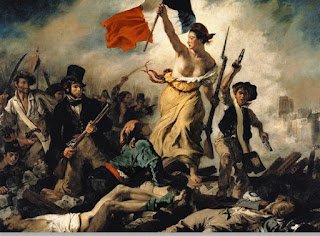
Liberty Leading the People, by Eugene Delacroix (1830).

Liberty Rights of Innocent Falling in the Regressive State

Updated - MADISON, WIS — As public faith in the Wisconsin and federal criminal justice systems remains low, the attorney for the once-exonerated Steven Avery will file a new legal petition containing a "huge amount of new evidence," an announcement reads today.

The case is State of Wisconsin v Steven Avery, featured in the Emmy-winning Making a Murderer docuseries.

Avery and his nephew, Brendan Dassey, were convicted of first-degree homicide for the 2005 murder of a young photographer, Teresa Halbach. Both men are serving life sentences.

The coming Avery-Zellner filing follows a Nov 2021 defeat at the Wisconsin Supreme Court that refused to hear a petition, in accordance with the Wisconsin Judiciary's abdication of its role as guardians of civil liberties and defendant rights.

Most see the Avery-Dassey saga as revenge prosecutions in Manitowoc and Calumet counties, an insular region of the state known for small-town justice — injustice.

Steven Avery's real crime was to be exonerated for a 1985 wrongful conviction, and then file a federal civil rights action against Manitowoc County, known locally as "corruption county." 

The State of Wisconsin needed corroboration of allegations in its frame-up against Avery in 2003, so in a grotesque action in 2005-06, threw an innocent 16-year-old Dassey into legal fires, with no consideration given to the fact Brendan Dassey was demonstrably innocent.

Now, the Avery and Dassey cases have become partisan lightening rods as leading Wisconsin Democratic Party officeholders, including Gov. Tony Evers (D) and Attorney General Joshua Kaul (D), have worked to block evidentiary hearings the publicly challenge rampant law enforcement misconduct

In a legal spectacle in the Spring 2021, Thomas Sowinski of Manitowoc swore in a statement that he saw the prosecution's key trial witness plant the murder victim's RAV4 vehicle on the property of Steven Avery.

In other words, a credible resident swears he caught conspirators red-handed in a frame-up scheme in Wisconsin's infamous murder case drawing headlines in state post-conviction litigation.

Sowinski appears the stuff of movies — maybe, some mused, in response Wisconsin's new attorney general would seek to vacate two murder convictions, amid a vow to clean up law enforcement in east-central Wisconsin.

DOJ delay strategy

The Wisconsin Dept of Justice quickly responded on April 16 to the Sowinski statement.

The DOJ filing includes unfounded accusations challenging attorney Zellner's ethics, and a bizarre statement complaining about the fact that Avery spotlights more prosecutorial misconduct for allegedly withholding exculpatory evidence — a Brady violation.

This is the same tactic launched at Zellner by the State of Missouri in her successful exoneration of Ryan Ferguson.

The DOJ asserted that the sheer multiplicity of alleged Brady violations in the record should be read against the defense.

Avery's attorney, Zellner, reacted with restrained outrage.

Zellner replied to the Court on April 22, 2021: "It is a supreme irony that in one of the most blatant examples of a wrongful conviction the State's only response is to falsely accuse Mr. Avery's lead counsel of nefarious conduct for discovering a 6th Brady violation. Rather than seeking justice, the State wants to 'slay the messenger' by putting forth more false allegations, a skill that it has mastered over the last 16 years. The State turns a blind eye towards its past actions of withholding exculpatory evidence."

The Democratic-led DOJ said nothing about the substance of Sowinski's sworn statement, or that the prosecution apparently failed to notify the defense about this witness after he contacted the Manitowoc Sheriff's department in 2005.

The defamatory ethics violation accusation against Zellner was quickly disconfirmed by Zellner and the DOJ never mentioned the matter again, failing to apologize and straighten out the record.

Dems stand with police

Why is the Democratic-led DOJ defending the work of Kenneth R. Kratz, former Calumet County District Attorney, (1992-2010), who was forced to resign in disgrace in 2010 for outrageous conduct in 2009, just two years after prosecuting the Avery-Dassey cases?

Kratz is self-described as suffering from narcissistic personality disorder, sexual compulsion disorder and multiple drug addictions.

Kratz described himself a "dick" for his work as district attorney in which he claimed he could not help himself harassing crime victims because of his disorders for which he was undergoing professional treatment, amid an allegation he possibly assaulted a woman.

Wisconsin Democratic Party officials, Gov. Tony Evers and Attorney General Joshua Kaul, have made the political decision to work for law enforcement, even Ken Kratz, against the wrongfully convicted.

This is political liberalism at its most vicious and irrational.

One month into his term in 2019, Kaul filed legal responses signaling the DOJ would stall Avery's  possible exoneration by filing procedural objections.

The quality of mercy towards the innocent appears to be exhausted under the warrant of Wisconsin Democrats.
--
Why are demonstrably innocent peoples' lives being destroyed in Wisconsin? 

Why do so many accept what the Wisconsin Judiciary and criminal justice system are doing?

It's an old story: See Milton Mayer's They Thought They Were Free: The Germans, 1933-45 (University of Chicago Press. ©1955).

Mayer, an American Jewish writer who had gone to Germany in the 1930s, made friends with 10 people, all of whom were members of the NAZI Party. He found them courteous, funny, genuine human beings whom he called "friends."

They were also fools and certainly were guilty.

---
From Milton Mayer:

But Then It Was Too Late

"What no one seemed to notice," said a colleague of mine, a philologist, "was the ever widening gap, after 1933, between the government. ..."

"What happened here was the gradual habituation of the people, little by little, to being governed by surprise; to receiving decisions deliberated in secret; to believing that the situation was so complicated that the government had to act on information which the people could not understand, or so dangerous that, even if the people could not understand it, it could not be released because of national security."

This separation of government from people, this widening of the gap, took place so gradually and so insensibly, each step disguised (perhaps not even intentionally) as a temporary emergency measure or associated with true patriotic allegiance or with real social purposes. And all the crises and reforms (real reforms, too) so occupied the people that they did not see the slow motion underneath, of the whole process of government growing remoter and remoter."

"You will understand me when I say that my Middle High German was my life. It was all I cared about. I was a scholar, a specialist. Then, suddenly, I was plunged into all the new activity, as the university was drawn into the new situation; meetings, conferences, interviews, ceremonies, and, above all, papers to be filled out, reports, bibliographies, lists, questionnaires. And on top of that were the demands in the community, the things in which one had to, was ‘expected to’ participate that had not been there or had not been important before. It was all rigmarole, of course, but it consumed all one’s energies, coming on top of the work one really wanted to do. You can see how easy it was, then, not to think about fundamental things. One had no time." ...

Jan 3, 2022

Prosecuting Jan. 6 'Cheerleaders' Is Madness

Commentary

Neo-liberal Authoritarianism Accelerates, Adopts Scott Walker Practice

Updated - Madison, Wisconsin — Corporate liberal media is boasting a woman who thought nothing would happen for attending the Jan. 6 protests is getting 60 days in federal prison, (Reilly, Huffington Post).

While Democrats cheer, this development should alarm all free-thinking Americans.

I have attended many politcal protests in Madison, Wisconsin.

Against Apartheid, against the CIA, for state legislation, for union rights, for women's choice, so forth.

Most of the protests were branded anti-American and insurrectionist.

In 2013, Gov Scott Walker, Secretary of Wisconsin Department of Administration (DOA), Mike Huebsch and Wisconsin State Capitol Police Chief, David Erwin, all worked specifically to halt protests at the Wisconsin Capitol.

At one point in August 2013, Walker's DOA's Capitol Police Chief actually ordered his cops to encircle people on the capitol rotunda and warn them against partisan "spectating" — (watching) an event or a gathering of people declared illegal by the Capitol police chief, (Kemble, The Progressive) (WKOW-TV (Madison)) (Rowan, Wisconsin Media Media Cooperative)

That same month, a local state representative was threatened with arrest for "spectating," (Davidoff, Isthmus). Hundreds of others were arrested for singing.

What is a shock is how many went along with this idiocy before U.S. District Judge William M. Conley put an end to this regime in Michael Kissick vs. Michael Huebsch and David Erwin, (Mal Contends).

Today, the Democratic-led U.S. Dept of Justice and Democrat U.S. District Judge Christopher Cooper are dishing out the same Scott Walker treatment on Jan. 6 protesters.

Jennifer Leigh Ryan is accused of cheerleading by Cooper, another ridiculous Democrat judge.

"I don’t think you could have missed the fact that this was no peaceful protest," Cooper said at today's sentencing hearing. "You were a cheerleader, you cheered it on."

So, what happened to the imminent, lawless action standard in Brandenburg v. Ohio, 395 US 444 (1969)?

First Amendment rights are dead now, as the Biden administration buries and hides these liberties under partisan attacks.

Writes Glenn Greenwald today:

When a population is placed in a state of sufficiently grave fear and anger regarding a perceived threat, concerns about the constitutionality, legality and morality of measures adopted in the name of punishing the enemy typically disappear. The first priority, indeed the sole priority, is to crush the threat. Questions about the legality of actions ostensibly undertaken against the guilty parties are brushed aside as trivial annoyances at best, or, worse, castigated as efforts to sympathize with and protect those responsible for the danger. When a population is subsumed with pulsating fear and rage, there is little patience for seemingly abstract quibbles about legality or ethics. The craving for punishment, for vengeance, for protection, is visceral and thus easily drowns out cerebral or rational impediments to satiating those primal impulses.

We live in dangerous times, and the Democrats are the villains.

We should not be surprised. It was four years ago when the J20 protesters of 2017 were prosecuted for holding to and expressing political views.

As police and state disruption of citizens exercising free speech rights has become normalized, the J20 case would, in a country dedicated to liberties of its citizens, become the focus of saturation media  coverage.

So, would the Jan 6 protesters today but not quite in the way liberals believe.

Nov 18, 2021

Wisconsin Supreme Court Denies Steven Avery Hearing; Court Follows Democrat Request

Wisconsin Supreme Court protects law enforcement
corruption, misconduct in denying Steven Avery petition.
Updated: Madison, Wisconsin — The attempted destruction of Steven Avery by the state of Wisconsin is proceeding apace.

Attorneys received notification of an expected denial of Avery's Aug. 25, 2021 Petition for Review from the Supreme Court of Wisconsin on Nov 17, 2021. 

Steven Avery and his nephew, Brendan Dassey, were convicted of first-degree homicide in Wisconsin in 2007 for the murder of a young photographer, Teresa Halbach.

The case is State of Wisconsin v Steven Avery, featured in the Emmy-winning Making a Murderer docuseries.  

The once-exonerated Steven Avery faces a vendetta from multiple foes, including the Wisconsin Democratic leadership, corrupt law enforcement and the Wisconsin Judiciary which has largely abdicated its role as protector of individual Constitutional rights in favor of covering for police misconduct.

The short Court statement includes no dissents, no explanation and no stated reasoning of the decision deliberated in secret. 

"It is ordered that the petition for review is denied," reads the statement, not housed on a public website.

Replied Zellner:

This lack of reasoning, lack of transparency, as well as materiel misstatement of facts and history by judges in this case continue to cast doubt on the decisions and the credibility of the Wisconsin judicatory.

This denial is the high court protecting the reputation of the criminal justice system and the Wisconsin Judiciary, and the public's job is to watch as innocent men remain is prison.

Avery seeks a public evidentiary hearing on new exculpatory evidence that was hidden by the prosecution for the purpose of blocking material facts pointing to Avery's innocence. 

He also seeks a new trial, reasoning that the non-existent case for his guilt combined with the clear law enforcement misconduct would make the scandal of another guilty trial verdict impossible.

The next step for Avery is to seek redress in federal court, or file in County Circuit Court.

The sheer number of documented Brady violations and other law reinforcement misconduct make refiling in County Court an easy matter.

In a legal spectacle in Spring 2021, Thomas Sowinski of Manitowoc swore in a statement that he saw the prosecution's key trial witness plant the murder victim's RAV4 vehicle on the property of the man convicted of homicide in 2007.

In other words, a credible resident swears he caught conspirators red-handed in a frame-up scheme in Wisconsin's infamous murder case drawing headlines in State post-conviction litigation.

The response of the DOJ was to invent an ethical violation of atty Kathleen Zellner's, and ignore the new evidence instead of launching an investigation and agreeing to an evidentiary hearing.

It is now conventional wisdom that the Wisconsin Judiciary enjoys no more credibility than, for example, the judiciary of Russia or Brazil.

Sep 12, 2021

Democrat-led Wisconsin Dept of Justice Is Terrified of Evidence Hearing in Making a Murderer Case

Eugene Higgins, The Black Cloud, oil on canvas,
Smithsonian American Art Museum
Democrats Block Public Light on Police Misconduct

Madison, Wisconsin — Misstatements, defamation, and refusal to address merits of Steven Avery's legal quest for a second exoneration define Democrat-led Dept of Justice misconduct in post-conviction litigation in State of Wisconsin v. Steven A. Avery, (Appeal Number 2017AP002288).

Unreported in Wisconsin corporate media is the fact the DOJ has gone to unprecedented lengths to block a hearing on law enforcement misconduct that helped frame two innocent Wisconsin men. The State strategy is to delay, defame and make political appeals to corrupt judges and other Wisconsin Democrats who have made the state the worst place to be innocent.

"If Mr. Avery's conviction truly has integrity it will withstand the scrutiny of an evidentiary hearing. Without such scrutiny the question of the integrity and fairness of Mr. Avery's trial hangs like a dark cloud over the Wisconsin criminal justice system," writes Avery attorney, Kathleen Zellner in his Aug 2021 petition to the Wisconsin Supreme Court, (p. 9).

Steven Avery and his nephew, Brendan Dassey, were convicted of first-degree homicide in Wisconsin in 2007 for the murder of a young photographer, Teresa Halbach.

Avery is appealing to the Wisconsin Supreme Court in post-conviction litigation, seeking a new trial or an evidentiary heating in his August 2021 petition.

Since assuming office as attorney general in 2019, Democrat Joshua Kaul has acted perversely in opposition to requested hearings on evidence, garnering disbelief from advocates for the wrongfully convicted and human rights activists.

Kaul is defending the bad work of the odious Ken Kratz, who admits numerous pathologies during his tenure as Calumet County District Attorney to explain away sexual and ethical misconduct in office, before being driven from office, and later resigning his license to practice law in Wisconsin.

Wisconsin attorney Jerome F. Buting has been practicing law here for 40 years. Buting has seen a lot in his practice.

But even Buting was apparently shocked by the conduct of the Democrat Dept of Justice — defying fairness and any sense that a defendant should obtain legal recourse to misconduct — blocking an evidentiary hearing.

Writes Buting on social media after the DOJ penned a bizarre response to Avery's petition before the Wisconsin Supreme Court, a DOJ reponse since publicly rebutted by Avery's attorney, Kathleen Zellner, devastating the DOJ.


It would be difficult for the Wisconsin Judiciary to fall any lower than it has.

The Wisconsin Judiciary has demonstrated that as a branch of government it is no longer an impartial body. Wisconsin courts can be counted on to take the side of corrupt police and dishonest prosecutors no matter how blatant the misconduct in criminal justice litigation.

It is expected in the innocence community that the Democratic-aligned appellate judges — Lisa S. Neubauer and Jeffrey O. Davis — would brush aside state misconduct to politically support Gov. Tony Evers and Attorney General Joshua Kaul, who work against the innocent.

Both Evers and Kaul are running for reelection in 2022, and a scandal implicating Democratic Party elected officials would likely prove disastrous to the Party, so Party functionaries on the bench and other branches are trying to bury Steven Avery.

Moreover, in the Avery case, Kaul's mother, Wisconsin Attorney General Peg Lautenschlager (2003-2007), was deep into covering for Manitowoc County's misconduct after the first wrongful conviction of Avery. Attorney General Kaul is covering for his Mother's old flacking for crooked police.

Wisconsin's evidence preservation law

One illustration of the DOJ and Democratic judges' perfidy concerns the State's returning the murder victim's remains to the Halbach family, a law enforcement scheme revealed when Avery sought to conduct DNA testing, and found out the bones had been destroyed without notice to him, in violation of Wisconsin's evidence preservation law.

Flaunting the evidence preservation law, in 2011 Calumet County Sheriff Deputy Jeremy Hawkins, Mark Wiegert,and DoJ Attorneys Thomas Fallon and Norman Gahn secretly sneaked the remains of Ms. Halbach, and illegally transported the bones to the Halbach family.

The State previously suggested to the Appellate Court in its Dec. 2018 filing that Avery and Zellner drop their appeal without the State ever having "admitted or disclosed that it had given the bones back to the Halbach family in 2011 [illegally] without notice to Mr. Avery or his counsel," notes Zellner in her Feb. 2019 legal filing.

In other words, law enforcement hid evidence it claims is the murder victim, destroyed this evidence, hid the destruction, lied about the destruction, then claimed the evidence cannot be determined to be exculpatory because it has been destroyed.

In short, the State acted in bad faith at every turn.

Even the prosecutor-biased Judge Angela W. Sutkiewicz acknowledges in 2020 what Zellner uncovered: Writes Sutkiewicz: "The report of Deputy [Jeremy] Hawkins indicates that he, Sergeant Investigator Mark Wiegert, Attorney Thoman Fallon and Attorney Norman Gahn removed materials stored in evidence, and released them to the Halbach family," (p 2).

The Appellate Court hearing the case in July 2021, however, divined, "The Halbach family requested these bone fragments for purposes  of  its  own—likely  for  closure ... ."

Yet, even the DOJ's Thoman Fallon and Norman Gahn who implemented the scheme disconfirm this attempt by the Court, contriving a State-Halbach family scheme, to cover for illegal evidence destruction.

Fallon and Gahn argue that the evidence they helped destroy was "inexplicably released" from the Calumet County Sheriff’s Department’s evidence control unit, March 29, 2019 legal filing, (p 13).

Fallon and Gahn, in effect, assert Fallon and Gahn cannot explain why they released and destroyed the evidence, and state nothing about the Court-invented 'family did it' offering by the appellate court.

This 'Halbach family did it' invention appears nothing so much as a public signal to the Halbach family to speak up and get on board with the lie of moment.

"Inexplicably released" is of course a disingenuous characterization for the illegal destruction of evidence that not only implicates Fallon, Gahn and Wiegert, but also is a clear violation of the Due Process Clause, and is a Brady violation under Wisconsin judicial doctrine.

Lost in all the Court and DOJ lies is the fact an innocent man is litigating for his very life.

Sep 9, 2021

Making a Murderer — Dark Cloud Hangs over Wisconsin Judiciary Amid Corruption Concerns

The once exonerated Steven Avery faces
his most malicious enemy in the
Democratic Party and a corrupt
Wisconsin Judiciary that has abdicated
its duty to act with impartiality. Damage,
destruction are the aims against Avery
and his nephew who have committed a
mortal sin in Wisconsin: Fighting back
against state violence and corrupt cops.

Avery Seeks New Trial and Evidentiary Hearing in a Corrupt State Court System

Commentary

Update II: Rebuttal to State's Response in Opposition of Mr. Avery's Petition. This is a devastating public explanation that the DOJ undoubtedly will misrepresent amid its posturing that there is nothing to see here.

Updated: Madison, Wisconsin — Steven Avery and his nephew, Brendan Dassey, were convicted of first-degree homicide in Wisconsin in 2007 for the murder of a young photographer, Teresa Halbach. 

Both men are serving life sentences following much criticized investigations and trials held in east-central Wisconsin, known locally for small-town justice and police corruption.

Avery is appealing to the Wisconsin Supreme Court in post-conviction litigation, seeking a new trial and an evidentiary heating in his August petition.

The case is State of Wisconsin v Steven Avery, featured in the Emmy-winning Making a Murderer docuseries.

But the once-exonerated Steven Avery faces a vendetta from multiple foes, including the Wisconsin Democratic leadership, corrupt law enforcement and the Wisconsin Judiciary which has largely abdicated its role as protector of individual Constitutional rights in favor of covering for police misconduct.

Yesterday, the Wisconsin DoJ filed a response opposing Steven Avery's petition for a hearing before the Wisconsin Supreme Court.

Avery seeks a public evidentiary hearing on new evidence that was hidden by the prosecution for the purpose of blocking material facts pointing to Avery's innocence. He also seeks a new trial, reasoning that the non-existent case for his guilt combined with the clear law enforcement misconduct would make the spectacle of another guilty trial verdict impossible.

Notes attorney Jerome Buting: "State’s response to Avery’s @ZellnerLaw petition opposes SCOW review, claiming SA was not treated differently because his case was 'the subject of a television show.' Really? In no other case has WI fought so desperately to avoid any evidentiary hearing."

At each point is his post-conviction litigation, the State DOJ has blocked, delayed, deterred and opposed Avery's quest for his second exoneration.

A reader ought consider this whole affair is not akin to sick, ole-boy Louisiana corruption. Louisiana, Mississippi, Alabama, Oklahoma and Missouri have nothing on Wisconsin police-prosecutor corruption, more insidious than any conduct our fellows to the South can conjure.

Few believe in the impartiality of the Wisconsin Judiciary which is capable of doing anything in service to a corrupt police force.

Wisconsin has a nefarious cast of characters in law enforcement, but the Avery and Dassey cases approach the demented.

Kenneth R. Kratz, former Calumet County District Attorney, (1992-2010), was forced to resign in disgrace in 2010 for outrageous sexual misconduct in 2009, perhaps earlier, just two years after prosecuting the Avery-Dassey cases.

Kratz is self-described as suffering from narcissistic personality disorder, sexual compulsion disorder and multiple drug addictions.

But the Wisconsin DoJ has defended the work of this same repulsive figure Kratz in Avery's post-conviction litigation, instead of launching an investigation into Wisconsin law enforcement, Kratz and other prosecutors' subsequent conduct to determine the reliability of convictions.

"
The State ... conveys an attitude of impunity for its past actions of withholding exculpatory evidence and its current action of continuing the concealment of its destruction of potentially exculpatory or useful evidence," writes Avery attorney, Kathleen Zellner in 2019 in a legal filing in appellate court.

The State of Wisconsin DoJ did worse in post-conviction litigation than convey an attitude of impunity. The DoJ has chided the defense for bringing multiple Brady violations to the attention of the Court, so strong is the prosecution's confidence that the Court will sustain the DoJ's positions.

Avery's attorney, Zellner, reacted with restrained outrage this posture.

Zellner replied to the Court on April 22, 2021: "It is a supreme irony that in one of the most blatant examples of a wrongful conviction the State's only response is to falsely accuse Mr. Avery's lead counsel of nefarious conduct for discovering a 6th Brady violation. Rather than seeking justice, the State wants to 'slay the messenger' by putting forth more false allegations, a skill that it has mastered over the last 16 years. The State turns a blind eye toward its past actions of withholding exculpatory evidence."

On July 28, 2021, the Court of Appeals (Dist II), delivered a results-oriented decision and opinion so blatant in adopting the State's errors that lay parties revealed the decision to be rife with misstatement, and misinterpretation of evidence (Reddit). Avery's attorney, Kathleen Zellner, followed up with a petition to the Wisconsin Supreme Court some four weeks later.

On Sept 8, 2021, when
the DoJ filed its response opposing Avery's petition for a hearing before the Wisconsin Supreme Court, and the large pro-Avery community around the world reacted with gasps and disgust.

This DOJ posture, haughty and disingenuous, raises the question, if the State is so certain that its conviction of Avery and Brendan Dassey are on the level, why does it oppose bringing the case to light before the State high court, an evidentiary hearing, and a new trial?

Avery advocates have noted that the DOJ failed to even challenge Avery's arguments in its response, instead taking on the tone of how dare you challenge the integrity of this conviction?

Attorney Zellner, who has seen every type of State depravity in her practice around the country freeing dozens of wrongfully convicted persons, seemed shook by the pathological tone of the Democrat-led Dept of Justice's latest filing that reads more like a politcal document subtly calling for Party loyalty that a legal filing made in good faith.

Zellner sent out three tweets, deleted two, before she noted: "If we had wanted to re-read the same error filled COA decision again we could have. The State’s Regurgitation Response addresses none of the errors —it just repeats them. Justice delayed again for Steven Avery."

If we had wanted to re-read the same error filled COA decision again we could have. The State’s Regurgitation Response addresses none of the errors —it just repeats them. Justice delayed again for Steven Avery. @MakingAMurderer

This is Wisconsin.

This is where Martin Lipske, a contemptible District Attorney in Iron County in northern Wisconsin, was driven into retirement just before Lipske fronted for child trafficking schemes.

So, the Wisconsin District Attorney Association named Lipske Prosecutor of the Year for the Department of Justice in 2016, and awarded Lipske the E. Michael McCann Award from the DA Association. 

The Wisconsin Judiciary cannot be counted on to police corrupt law enforcement, certainly not an odious figure like Kratz and the Democrat-led Wisconsin Dept of Justice.

Behind the scenes, the DOJ's attempt to rewrite the state's Brady doctrine will figure into this case.

The four Republicans on the Wisconsin Supreme Court are Avery's hope as Wisconsin Democrats will do their worst to protect wrongful convictions of Steven Avery and Brendan Dassey.

The DOJ dismissal of a Brady violation claim is preposterous, for instance, that even the DOJ notes features the defense failure to raise an issue of omission to which the defense was never alerted.


May 17, 2021

Outrageous Criminal Justice System Supported by Dems and Republicans

Madison, Wisconsin —  Police are free to harass, lie, defame, steal, plant evidence, maim and kill because elected policymakers give cops the green light.

In Louisville, Police Detective Mark Handy lied and planted evidence to send four men to prison.

Local and federal prosecutors and fellow cops knew about Handy, noone said a word — afterall, prosecutors and cops had to consider convenience and career before they stood up for people whom they knew to be innocent.

Edwin Chandler spent 10 years in prison because of Handy’s lies. Chandler pronounced the criminal justice system "broken."

Mark Handy will serve one year in prison for destroying four lives.

Police dishonesty and malice is an old story, an old crime, and without black liberation workers, nothing here would change.

"One of the reasons you've seen the advent of criminal [justice] reform movements like Black Lives Matters and other kinds of movements that have come about, is because the system had swung so far to law enforcement," because, in part, the immunity that gives law enforcement impunity to break the law in "outrageous" ways, said attorney Mark Geragos, (Interview with Edward Michael Johnston, a Senior Lecturer in Law at the University of the West of England Bristol in interview, Criminal Justice Natters.)

Consider bellwether Wisconsin

The Wisconsin legislature will enact no legislation to deincarcerate, defund and hold police accountable. The legislature will not even consider legislation that helps the wrongfully convicted.

Democratic Wisconsin State Sen Tim Carpenter (Milwaukee), a monument to Democratic Party inaction, continues his work against black and brown citizens, and Black Lives Matter, while sponsoring lame legislation with the rationale that racist Milwaukee police allied with Carpenter should live within municipal boundaries.

Not a banner year for police reform here almost one year after the police murder of George Floyd, though Carpenter did manage to co-sponsor a bill last year that criminalizes damaging statues.

The innocent languish is Wisconsin prisons, as Attorney General Joshua Kaul (D) and Gov Tony Evers (D) work to keep wrongfully convicted imprisoned, while defending the criminal justice system as just and fair, instead of corrupt and crooked.

Mar 13, 2021

Steven Avery Attorney: '100 Percent Sure Who Killer Is, What Happened'

Madison, Wisconsin — The exonerated Steven Avery made internationally famous in the Emmy-winning documentary, Making a Murderer, is facing his most grave challenge yet.

Mr. Avery is fighting for his freedom again after being framed by Wisconsin law enforcement a second time in 2007 after he sued Manitowoc County for $36-million for his first wrongful conviction in 1985.

Post-conviction litigation is being pursued by Avery's attorneys, Kathleen T. Zellner and Steven G. Richards, in the Wisconsin court system (State of Wisconsin v. Steven A. Avery, Appeal Number 2017AP002288). The case is awaiting decision in state appellate court (Work with KZ).

This week, Avery's attorney, Kathleen T. Zellner, spoke with Edward Michael Johnston, a Senior Lecturer in Law at the University of the West of England Bristol.

In the interview conducted via Zoom March 12 with Dr. Johnston for his YouTube channel, Criminal Justice Natters, Ms. Zellner offered that she knows who the actual killer of Teresa Halbach is, and what the circumstances are.

"I'm absolutely, 100 percent sure that he's [Steven Avery] innocent. I'm 100 percent sure I know who the killer is and exactly how this happened," said Zellner at the 32-minute mark.

Viewers of the docu-series would love to hear Zellner's theories on the murder but will have to wait until the time is right procedurally for this to be revealed.

Experts believe naming the killer outright publicly in an ongoing post-litigation case could infringe the presumption of innocence, and potentially could lead to destruction of evidence, or perhaps goad the killer into fleeing, among other developments.

Zellner, a veteran of many wrongful conviction cases, said killers almost always confide in other people, and suggested it is just a matter of time before the killer is brought to justice.

Meanwhile, Brandan Dassey, also convicted of helping to kill Ms. Halbach, and his supporters are pressuring Wisconsin Governor Tony Evers for a full pardon, in light of the lack of a case against Dassey.

The cases remain a stain on the Wisconsin legal system and the state Dept of Justice. 

The District Attorney, Ken Kratz, who prosecuted both the Avery and Dassey cases resigned in disgrace in 2010 after sexual assault and harassment allegations against him came to light and Gov Jim Doyle began removal proceedings.

Kratz has retired from the practice of law following a complaint with the Wisconsin Office of Lawyer Regulation by Wisconsin resident Michael Leon for misrepresentation of his ability to practice law and his license status. 

Kratz has reportedly moved from Wisconsin.

Still, the Wisconsin Dept of Justice stubbornly defends the case against Dassey brought by a disgraced district attorney in a severely biased jurisdiction.

The Zellner-Johnston interview is below:

Nov 6, 2020

Joe Biden Needs to Speak the Truth

Madison, Wisconsin — Joe Biden's response to Trump's imprecations during ballot tabulation is apt.

But the time for sophistry and hollow rhetoric — and there is occasion for this — has passed.

Biden's communications sound like a hostage reading a script he neither believes nor understands.

His 'stay-calm' posturing omits mention of the psychopath in the White House, and the lunatic's design on our democratic process.

Just a minor disagreement about priorities while democratic processes work themselves out, Joe?

While Biden's neo-lib speechwriters are vested in a comm strategy that speaks to people like they are a collective group about to leap from a building, candor about what Trump is doing is critical.

We the people can handle the truth, and we would appreciate a president-elect who gets this.

Nov 4, 2020

A Wisconsin Victory Feels Like We Are Mourning

Madison, Wisconsin - "Joe may win. But it feels like we lost something important last night," said Andrew Yang on social media this morning.

Yang's sentiment seems widely held here as most of the people I have spoken to seem in mourning despite Biden's apparent victory here, and in the national Electoral College.

There is a major national Party that is racist and hostile to the idea of democracy.

But the Democratic Party's strategic project seems to be sabotaging progressive reformers in service to big money, virtue signaling and identity politics.

This is not healthy for a democratic republic. It's fatal.

"The richest and most powerful country on earth — whether due to ineptitude, choice or some combination of both — has no ability to perform the simple task of counting votes in a minimally efficient or confidence-inspiring manner. As a result, the credibility of the voting process is severely impaired, and any residual authority the U.S. claims to 'spread' democracy to lucky recipients of its benevolence around the world is close to obliterated," writes Glenn Greenwald this morning.

Nov 3, 2020

Election Day Is Sedate at Madison, Wisconsin Polls Staffed by Young People

Meadowridge Library in Madison Wisconsin
Election Day 2020 - No voters in sight

Updated - Madison, Wisconsin - A beautiful day and young, new faces greeted the veritable trickle of voters observed today.

On the southwest side, two polling places saw barely a trickle of voters at approximately 10 a.m., continuing a quiet morning across the city during this Pandemic election.

Polling workers skewed very young in a radical departure from a typically high number of folks of retired age. 

Increased number of turnout checks reported to the City Clerk includes scheduled counts at 9, 11 in the morning and  1, 4, 6 and 7 in the p,m., a poll worker said. 

The high turnout-reporting is a consequence of the mammoth number of early voting, and the resultant feeding of ballots into tabulators all day.

Some 20 young workers staffing the polls this morning vastly outnumbered observed voters present over a half-hour period at two separate southwest Madison polling sites.

Young poll workers saved this Election today. 

The City Clerk and other election officials have been sending out thank yous for weeks.

One observer and a poll worker say they expect results from the City to come no later than usual on presidential general election day.