- Another soldier’s suicide underscores the VA’s enormous challenge: Keeping veterans alive, as the U.S. Army last week in a maddeningly obtuse report blames "high risk behavior" of troops at home and "erosion of adherence to existing Army policies and standards." ... "[Iraq war veteran Iraq war veteran Kortney Jensen] was never the same person after he came home,” said father-in-law, Grant Becherini. “It was a different Kort that came back. The real Kort died over there." Not according to the Army. -
The demons would always be there. Just over his shoulder, just within earshot, just close enough to remind him that his life would never be what it was.
They would keep him from sleeping. They would befuddle him in the midst of simple tasks. And, on occasion, they would entreat him to end it all.
But Kortney Jensen was a fighter. He had endured two tours of duty in Iraq, survived more than 75 roadside bomb detonations and was twice awarded the Purple Heart.
And in this new fight, he was well armed. He had the unconditional support of his family. He was plugged into mental health treatment at the Veterans Affairs hospital in Salt Lake City. And he was looking forward to the future: a friend’s wedding, a vacation with his mother and the birth of his second daughter.
With all of that to live for and more, the 27-year-old Army veteran had made it through some very dark days. He’d beaten back the demons.
But he could not destroy them.
—
‘We are getting better’ » Since 2001, the U.S. Department of Defense has acknowledged the deaths of more than 5,600 military members in Iraq and Afghanistan — a grim, flag-draped tally that has contributed to a significant loss of support for two once-popular wars.
But the count is incomplete. The Department of Veterans Affairs believes that more than 6,000 veterans — including many who have served in the nation’s ongoing conflicts — will commit suicide this year. VA officials say many of these deaths are as much a consequence of combat as those resulting immediately from bombs or bullets.
In the long run, the National Institute of Mental Health has estimated, suicide will eclipse roadside bombings as the leading cause of death among those who have fought in Iraq and Afghanistan.
Yet it could be worse. The VA has endured years of criticism for being slow to react to the suicide crisis; some have even suggested that its behemoth bureaucracy has aggravated the mental health woes of those it was serving. But in recent years, veterans advocates have become more laudatory of the VA’s network of anti-suicide programs. Counselors working 24-7 at VA suicide hot lines have been credited with preventing thousands of deaths. And studies have shown that young veterans being treated by the VA are less likely to commit suicide than those who are not receiving services.
“I do feel like we are getting better,” said Dan Murchie, a counselor who works in a clinic for veterans of the wars in Iraq and Afghanistan at the VA hospital in Salt Lake City. “I think we’re starting to get a reputation as the team that can get things done, the team that can cut through the bull — the red tape — and help them get what they need to get better.”
One irony: Improvements in the way Murchie’s team works to prevent suicide have often come as a result of evaluating where they might have failed veterans like Jensen, who shot himself in the garage of a friend’s home on July 31.
“Right off, I ask: ‘Do I know this guy? When was the last time my team had interaction with him? What more could we have done?’ ” Murchie said.
Those were the same questions Murchie asked following the 2007 suicide of Iraq war veteran Jason Ermer.
Ermer’s mother said the Army abandoned her son, forcing him out of the service after he returned from combat with symptoms of post-traumatic stress. She believes that the care he received from the VA was inconsistent at best — and dehumanizing at worst.
“He was heartbroken,” Rosa Ermer said in 2009. “He went over to Iraq, he served his country with pride, and then they took everything away from him. They knew he had problems and they didn’t take care of him.” Murchie — who made the call to police that led to the discovery of the Ermer’s soldier’s body — said he will always question whether he could have done more to save the soldier. All he can do now, though, is learn from the past and move forward.
But sometimes, he said, the answer is that “we did the best we could ... and that’s the most frustrating thing of all.”
—
‘He’d want to go, too’ » Jensen was working on a ranch in Idaho when he heard about the Sept. 11 terrorist attacks. Soon he was in a soldier’s uniform. And it wasn’t too long after that he was called into the fight.
His posting with the 3rd Infantry Division wasn’t a glamorous job, but someone needed to lay asphalt to replace roads being destroyed by insurgent bombs near Balad, in northern Iraq.
“We were too embarrassed to tell people what we did,” Jensen’s friend, Josh Hansen, recalled. “We were trained as combat engineers. We went over there to blow stuff up, but all we were doing was fixing things that other people had blown up.”
Mortars dropped onto the base every day, exploding this way and that. Sometimes the bombs were deadly, but mostly the blasts were a nuisance. Sometimes when the alarms sounded Jensen and Hansen would race to the mess hall, hoping to make it through the doors before the base was locked down for safety. Say what you will about Army food, they found it better to be locked in than locked out.
“We really became very close during that year,” Hansen remembered.
So close that, when Hansen decided to volunteer for a return trip to Iraq, Jensen was right at his heels.
“I purposefully didn’t tell Kortney about it, because I knew that if I told him he’d want to go, too, and I had so much love for him that I just didn’t want to see him go back there,” Hansen said. “So I waited until just five days before I was supposed to leave. I figured he wouldn’t be able to get orders that fast.”
He was wrong.
‘These disorders can ebb and flow’: Post-traumatic stress disorder is an exasperatingly inequitable disease.
For some, the experiences that Jensen had during his first tour in Iraq — dodging mortar attacks on base and rolling “outside the wire” on bomb-laden roads — could be enough to trigger a lifetime of anxiety, fear and hyper-vigilance. Other soldiers weather such experiences with relative ease, suffering only when repeatedly exposed to great levels of violence over a long period of time. And still others appear to be immune altogether.
Treatment results for those who suffer from PTSD are also uneven.
“Some people just don’t respond to treatment,” said Jennifer Romesser, a neuropsychologist at the Salt Lake VA. “The vast majority of people do well — they see significant recovery — but these disorders can ebb and flow over time.”
Nearly 10,000 veterans are being treated for PTSD at the Salt Lake VA. Complicating matters for many of those individuals, and particularly for veterans of the wars in Iraq and Afghanistan, is an injury that is fast becoming the trademark wound of the anti-insurgent warfare era: traumatic brain injury caused by the concussive, brain-rattling force of improvised bomb blasts.
Researchers have a great deal of information on brain injuries related to civilian accidents — falls, car crashes, sports injuries and industrial explosions. The worst of those injuries are thought to be similar in nature to what soldiers suffer in roadside bomb blasts. What is less certain, however, is what happens when brain injuries are combined with psychological wounds.
“Brain injuries could certainly contribute and exasperate the difficulties and symptoms of PTSD,” Romesser said.
One troubling symptom inherent to both conditions: impulsivity, or the inclination to engage in dangerous, deadly or even suicidal behavior without forethought. And veterans, Romesser noted, often have the means to act quickly upon suicidal impulses.
“In some cases, when they come home, they are never comfortable being disarmed,” Romesser said. “So they keep a weapon near them at all times. It’s deeply ingrained in them, but it can also be a risk factor.”
More than half of veterans’ suicides involve a firearm.
‘We were saving lives’ » Jensen’s second tour of duty began in the fall of 2007. This time, instead of building roads, he was responsible for clearing them. Night after night, his team of bomb hunters from the 321st Engineers of Boise, Idaho, set off in heavily armored vehicles in search of the hidden killers buried under the roads of Iraq’s volatile Anbar Province.
“We were pretty damn good at it,” said fellow soldier Chris Koeppel. “Kort was a huge part of that. He was a quick thinker. He was always right up front when things were going down.”
Jensen, a sergeant, and his team took pride in finding more bombs than anyone else — even though the way they found many was when their vehicles were rocked by explosions. “Better that we find them that way than for others who had less armor,” Koeppel said. “We were saving lives.”
In late July of 2007, a massive bomb detonated under Jensen’s vehicle, violently slamming the soldier against the inside walls of the machine.
Against his pleas, Jensen was evacuated from Iraq, first to a hospital in Germany, and later to Brooke Army Medical Center in San Antonio, Texas. There, he convalesced with military members who had been badly burned and lost limbs in roadside bomb blasts, the very sort of explosions his team had worked so hard to prevent.
“He felt like they deserved to be there a lot more than he did,” said Jensen’s wife, Laura. “He felt like his injuries were nothing compared to anyone else’s.”
The military and the VA disagreed. So did Jensen’s mother. “His body hurt all over,” said Mary Heiner. “His head, his neck, his spine. All of him hurt. He couldn’t sleep. He had night terrors. He couldn’t concentrate. He was just struggling so much.”
“He was never the same person after he came home,” said Jensen’s father-in-law, Grant Becherini. “It was a different Kort that came back. The real Kort died over there.”
Ultimately, the VA would rate Jensen completely disabled. It was not a badge he wore with pride, but he struggled to build a new life for himself. He took up trapping. He joined a veterans’ motorcycle club. And he sought and received counseling at the VA.Slowly, family members said, Jensen seemed to have climbed out from the darkness. “He was always talking about the future,” Laura Jensen said. “All the time we talked about things we were going to do. We talked about the baby we were about to have.”
No one knows why Jensen ultimately decided to take his life. He didn’t tell anyone he was considering suicide. He didn’t leave a note.
—
No one is to blame » Andrew Wittwer knows he can’t save them all.
The case manager has worked at the Salt Lake VA for eight years, a period coinciding with an onslaught of new patients from the wars in Iraq and Afghanistan.
Early on, he concedes, the VA wasn’t up to the challenge. But over time, he believes, the system has gotten much better at keeping veterans from falling through the cracks.
But sometimes, he said, veterans won’t take advantage of all the services they are offered. And other times, he lamented, those services aren’t enough to combat the problems they face.
Nine veterans who were enrolled in the Salt Lake VA have killed themselves since October, officials reported.
“It’s heartbreaking,” Wittwer said. “There are challenges that I just can’t solve for them. There are things that are out of my control. ... All I can do is try to catch every possible scenario I can.”
The VA will conduct investigations into Jensen’s suicide in search of anything that could have been done to prevent his death.
But at least among Jensen’s family, the consensus is that the VA did all it could. “Sometimes things just happen,” Heiner said. “And no one is to blame.”
But if, in the process of investigating her son’s death, the VA comes upon something it could have done to save her boy’s life, Heiner said she would not be angry, but hopeful. “Whatever we can do now to save other people, we should,” she said. “That is the only good that comes from something like this.”
Peter Beinart has an excellent piece on how the Israeli occupation of the West Bank inexorably led the Anti-Defamation League into abandoning its principles, culminating in the awful decision to call for banning the Islamic Center in lower Manhattan.
Let me add two thoughts.
First, this has been building for a very long time. I remember my first visit to Israel, in 1981; even then older Israeli academics, veterans of an earlier era (literally — many of them had fought in 1967 and 1973), would talk grimly about the Likud government and its harsh policies, saying things like “I feel as if we’re living under a foreign occupation.” And it’s only gotten worse since then.
Second, Beinart doesn’t talk as much as I’d like about how this relates to U.S. politics. As he says, American liberals, while they fiercely support Israel’s right to exist, can’t bring themselves to support the policies of Israel’s current government. So the Israel-is-always-right crowd has gravitated to people who don’t have any problem with the occupation — which means the American hard right, including the Christian right. And they seem oblivious to the fact that they are thus making an alliance of convenience with the enemies of tolerance.
Anyway, it has been gratifying to see how many people understand just how wrong the ADL was; and special props to Mayor Bloomberg, who said exactly the right things.
I just finished reading the meat of the decision. Chief Judge Vaughn Walker has ruled Prop 8 is unconstitutional on both Equal Protection and Due Process grounds. Huge win. The decision is likely to be appealed to the Ninth Circuit Court of Appeals. Developing…
Here’s the conclusion from the decision.
CONCLUSION Proposition 8 fails to advance any rational basis in singling out gay men and lesbians for denial of a marriage license. Indeed, the evidence shows Proposition 8 does nothing more than enshrine in the California Constitution the notion that opposite-sex couples are superior to same-sex couples. Because California has no interest in discriminating against gay men and lesbians, and because Proposition 8 prevents California from fulfilling its constitutional obligation to provide marriages on an equal basis,the court concludes that Proposition 8 is unconstitutional.
REMEDIES Plaintiffs have demonstrated by overwhelming evidence that Proposition 8 violates their due process and equal protection rights and that they will continue to suffer these constitutional violations until state officials cease enforcement of Proposition 8. California is able to issue marriage licenses to same-sex couples, as it has already issued 18,000 marriage licenses to same-sex couples and has not suffered any demonstrated harm as a result, see FF 64-66; moreover, California officials have chosen not to defend Proposition 8 in these proceedings.
Because Proposition 8 is unconstitutional under both the Due Process and Equal Protection Clauses, the court orders entry of judgment permanently enjoining its enforcement; prohibiting the official defendants from applying or enforcing Proposition 8 and directing the official defendants that all persons under their control or supervision shall not apply or enforce Proposition 8. The clerk is DIRECTED to enter judgment without bond in favor of plaintiffs and plaintiff-intervenors and against defendants anddefendant-intervenors pursuant to FRCP 58.
Plaintiffs challenge Proposition 8 under the Due Process and Equal Protection Clauses of the Fourteenth Amendment. Each challenge is independently meritorious, as Proposition 8 both unconstitutionally burdens the exercise of the fundamental right to marry and creates an irrational classification on the basis of sexual orientation.
Why does the Obama administration refuse to come straight with the American people, explaining the reality of our economy?
It's in their political interests. Its the right thing to level with the people whom the President is supposed to serve.
But our president's economic point-people more often than not sound like the character, Squealer, in Orwell's Animal Farm: Here's why everything is getting better and better ... .
Here’s the reality: the stimulus was too small; we’re not seeing growth at a pace that will bring unemployment down rapidly, if at all; we clearly should be doing more; but obstructionism from Republicans is preventing action. And the administration knows all this perfectly well.
So one way to play this politically would be to tell the truth, and try to place the onus on Republicans, accusing them of perpetuating high unemployment.
Instead, however, the administration has decided to engage in happy talk, saying that it’s all good.
Do they really think this will work? I mean, I live in fairly rarefied circles (that’s not a boast, it’s an admission of inadequacy), and even so I know a number of people whose lives have become a living hell: men in their late 50s who fear they’ll never work again, small business owners who have lost everything. Does the administration really believe that it can convince these people that it’s all on the mend?
- Speak not, American liberals. Veterans Today condemns them as the Hitler Youth of Israel—Vicious and bigoted, forcing perceived sub-human Arabs out of their homes for Jewish settlers to move in; President Obama responds by doing nothing -
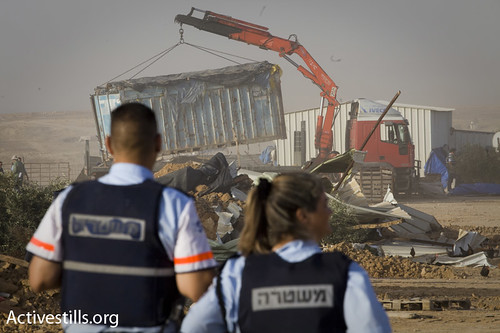
AL-ARAKIB, ISRAEL — On July 26, Israeli police demolished 45 buildings in the unrecognized Bedouin village of al-Arakib, razing the entire village to the ground to make way for a Jewish National Fund forest. The destruction was part of a larger project to force the Bedouin community of the Negev away from their ancestral lands and into seven Indian reservation-style communities the Israeli government has constructed for them. The land will then be open for Jewish settlers, including young couples in the army and those who may someday be evacuated from the West Bank after a peace treaty is signed. For now, the Israeli government intends to uproot as many villages as possible and erase them from the map by establishing “facts on the ground” in the form of JNF forests. (See video of of al-Arakib’s demolition here) and below.
Moments before the destruction of the Bedouin village of al-Arakib, Israeli high school age police volunteers lounge on furniture taken from a family's home. The following four photos are by Ata Abu Madyam of Arab Negev News.
One of the most troubling aspects of the destruction of al-Arakib was a report by CNN that the hundreds of Israeli riot police who stormed the village were accompanied by “busloads of cheering civilians.” Who were these civilians and why didn’t CNN or any outlet investigate further?
I traveled to al-Arakib yesterday with a delegation from Ta’ayush, an Israeli group that promotes a joint Arab-Jewish struggle against the occupation. The activists spent the day preparing games and activities for the village’s traumatized children, helping the villagers replace their uprooted olive groves, and assisting in the reconstruction of their demolished homes. In a massive makeshift tent where many of al-Arakib’s residents now sleep, I interviewed village leaders about the identity of the cheering civilians. Each one confirmed the presence of the civilians, describing how they celebrated the demolitions. As I compiled details, the story grew increasingly horrific. After interviewing more than a half dozen elders of the village, I was able to finally identify the civilians in question. What I discovered was more disturbing than I had imagined.
Israeli police youth volunteers pick through the belongings an al-Arakib family
Arab Negev News publisher Ata Abu Madyam supplied me with a series of photos he took of the civilians in action. They depicted Israeli high school students who appeared to have volunteered as members of the Israeli police civilian guard (I am working on identifying some participants by name). Prior to the demolitions, the student volunteers were sent into the villagers’ homes to extract their furniture and belongings. A number of villagers including Madyam told me the volunteers smashed windows and mirrors in their homes and defaced family photographs with crude drawings. Then they lounged around on the furniture of al-Arakib residents in plain site of the owners. Finally, according to Matyam, the volunteers celebrated while bulldozers destroyed the homes.
“What we learned from the summer camp of destruction,” Madyam remarked, “is that Israeli youth are not being educated on democracy, they are being raised on racism.” (The cover of the latest issue of Madyam’s Arab Negev News features a photo of Palestinians being expelled to Jordan in 1948 juxtaposed with a photo of a family fleeing al-Arakib last week. The headline reads, “Nakba 2010.”)
According to residents of al-Arakib, the youth volunteers vandalized homes throughout the village
The Israeli civilian guard, which incorporates 70,000 citizens including youth as young as 15 (about 15% of Israeli police volunteers are teenagers), is one of many programsdesigned to incorporate Israeli children into the state’s military apparatus. It is not hard to imagine what lessons the high school students who participated in the leveling of al-Arakib took from their experience, nor is it especially difficult to predict what sort of citizens they will become once they reach adulthood. Not only are they being indoctrinated to swear blind allegiance to the military, they are learning to treat the Arab outclass as less than human. The volunteers’ behavior toward Bedouins, who are citizens of Israel and serve loyally in Israeli army combat unitsdespite widespread racism, was strikingly reminiscent of the behavior of settler youth in Hebron who pelt Palestinian shopkeepersin the old city with eggs, rocks and human waste. If there is a distinction between the two cases, it is that the Hebron settlers act as vigilantes while the teenagers of Israeli civilian guard vandalize Arab property as agents of the state.
The spectacle of Israeli youth helping destroy al-Arakib helps explain why 56% of Jewish Israeli high school students do not believe Arabs should be allowed to serve in the Knesset – why the next generation wants apartheid. Indeed, the widespread indoctrination of Israeli youth by the military apparatus is a central factor in Israel’s authoritarian trend. It would be difficult for any adolescent boy to escape from an experience like al-Arakib, where adults in heroic warrior garb encourage him to participate in and gloat over acts of massive destruction, with even a trace of democratic values.
Youth volunteers extract belongings from village homes as bulldozers move in
As for the present condition of Israeli democracy, it is essential to consider the way in which the state pits its own citizens against one another, enlisting the Jewish majority as conquerers while targeting the Arab others as, in the words of Zionist founding father Chaim Weizmann,“obstacles that had to be cleared on a difficult path.” Historically, only failing states have encouraged such corrosive dynamics to take hold. That is why the scenes from al-Arakib, from the demolished homes to the uprooted gardens to the grinning teens who joined the mayhem, can be viewed as much more than the destruction of a village. They are snapshots of the phenomenon that is laying Israeli society as a whole to waste.
A radical, right-wing charismatic evangelical movement is burrowing into the power structures of major American cities and states; if Sarah Palin runs for president in 2012 we could have a New Apostolic Reformation president.
 - Another soldier’s suicide underscores the VA’s enormous challenge: Keeping veterans alive, as the U.S. Army last week in a maddeningly obtuse report blames "high risk behavior" of troops at home and "erosion of adherence to existing Army policies and standards." ... "[Iraq war veteran Iraq war veteran Kortney Jensen] was never the same person after he came home,” said father-in-law, Grant Becherini. “It was a different Kort that came back. The real Kort died over there." Not according to the Army. -


 Israeli police youth volunteers pick through the belongings an al-Arakib family
 According to residents of al-Arakib, the youth volunteers vandalized homes throughout the village
 Youth volunteers extract belongings from village homes as bulldozers move in